
Aerial Work Platform Basics: Types, Functions, and How to Choose the Right One
Aerial Work Platforms (AWPs) are essential equipment in construction, maintenance, warehouse operations, and industrial installations. Choosing the right type of machine can significantly improve safety, efficiency, and cost control.
This guide gives a clear overview of AWP types and how to select the correct machine for your job.
1. What Is an Aerial Work Platform?
An Aerial Work Platform (AWP) is a mechanical device used to provide temporary access for workers to elevated areas.
It is commonly used for:
- Building maintenance
- Electrical installation
- Warehouse operations
- Outdoor construction work
- Equipment repair at height
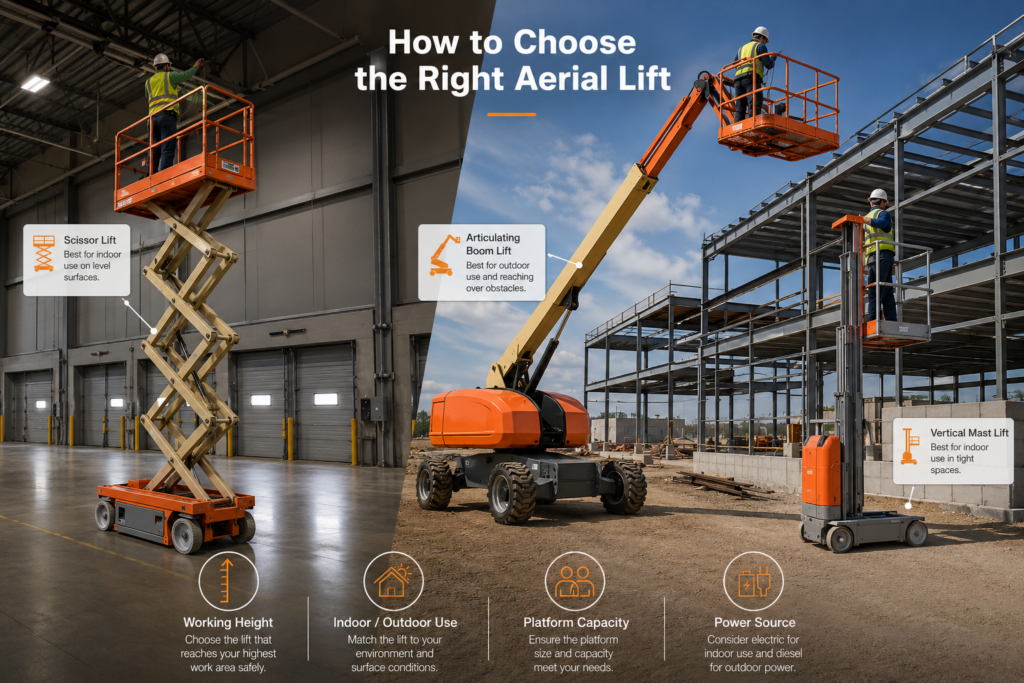
2. Main Types of Aerial Work Platforms
1) Scissor Lift
Best for vertical lifting in straight up-and-down movement.
Key features:
- Large working platform
- High stability
- Indoor & outdoor use
Typical applications:
- Warehouse maintenance
- Ceiling installation
- Indoor construction
2) Boom Lift (Articulated / Telescopic)
Best for reaching difficult or high-access areas.
Key features:
- Long horizontal outreach
- Flexible arm movement
- Suitable for complex job sites
Typical applications:
- Building exterior repair
- Tree trimming
- Industrial maintenance
3) Vertical Mast Lift
Compact machine for tight spaces.
Key features:
- Lightweight design
- Easy indoor maneuvering
- Narrow structure
Typical applications:
- Shopping malls
- Airports
- Maintenance in narrow aisles
3. How to Choose the Right AWP
When selecting an aerial work platform, consider the following:
✔ Working Height
Always confirm maximum required height with safety margin.
✔ Load Capacity
Check how many workers and tools will be on the platform.
✔ Indoor or Outdoor Use
- Indoor → electric models preferred
- Outdoor → rough terrain or diesel models
✔ Ground Conditions
- Flat floor → scissor lift
- Uneven ground → rough terrain boom lift
✔ Reach Requirement
If you need horizontal outreach, choose a boom lift instead of a scissor lift.
4. Safety Considerations
Before operating any AWP:
- Inspect machine before use
- Check load limits
- Ensure proper training
- Avoid unstable ground conditions
- Use personal protective equipment (PPE)
Safety is always the first priority in aerial work operations.
5. Why Understanding Your Machine Matters
Knowing your AWP type and specifications helps you:
- Select correct spare parts
- Avoid machine downtime
- Improve maintenance efficiency
- Reduce operational costs
This is also the foundation for correctly identifying OEM spare parts in future maintenance work.
Conclusion
Aerial Work Platforms come in different types, each designed for specific working environments. Understanding their structure and function helps you choose the right equipment and maintain it properly.
Whether it’s scissor lifts, boom lifts, or mast lifts—correct selection directly impacts safety and efficiency.