
Industry News | August 17, 2026
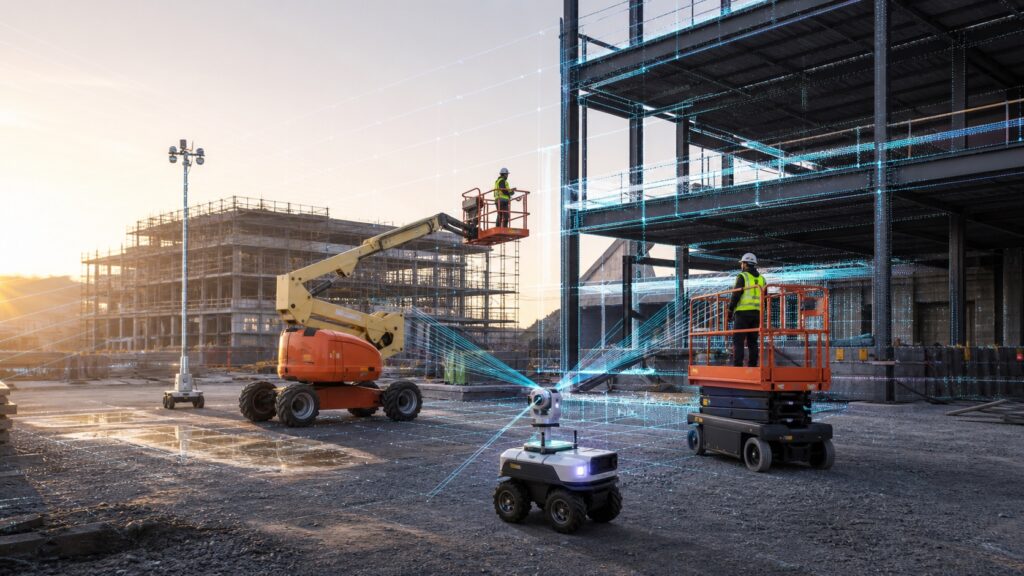
Oshkosh Corporation, the parent company of JLG Industries, announced a strategic equity investment in Nextera Robotics on August 6, 2026. The move connects one of the access industry’s best-known equipment businesses with a construction-technology company focused on visual AI, autonomous robotics and continuously updated digital maps of active jobsites.
The announcement does not introduce a new production JLG machine. Instead, it signals where connected access equipment may be heading: beyond reporting machine location and operating data toward participating in a wider digital jobsite where equipment, progress information and autonomous systems work together.
What Oshkosh and JLG Announced
According to JLG’s official announcement, Oshkosh made a strategic equity investment in Nextera Robotics as part of its broader “job site of the future” strategy.
Nextera develops technology that uses visual AI and autonomous robotics to create updated digital representations of active construction sites. These maps can provide project teams with more timely information about progress, quality and safety conditions, helping them identify issues earlier and make better decisions.
JLG said it will support Nextera’s commercialization through customer engagement, field validation and application expertise. In return, Nextera’s technology platform may complement JLG’s connected-equipment roadmap. JLG also stated that the companies will explore how the technology could be used in future products.
Why This Matters to the Access Industry
Telematics has already changed fleet management by making machine location, utilization, fault information and maintenance status easier to monitor. The next stage may connect that machine data with a live understanding of the jobsite itself.
For mobile elevating work platforms and telehandlers, that could eventually support several practical use cases:
- Comparing equipment utilization with actual project progress
- Identifying congestion, access restrictions or changing work zones
- Improving dispatch decisions as jobsite conditions evolve
- Providing better context for maintenance and downtime events
- Supporting coordinated workflows between people, machines and digital planning systems
- Collecting field information without relying only on manual site walks
These are potential directions, not confirmed features or release dates. The immediate importance of the investment is strategic: a major access-equipment manufacturer is treating autonomous site mapping and visual AI as technologies worth validating with real customers and field applications.
From Connected Machines to Connected Work
Traditional fleet connectivity begins with the machine. It answers questions such as: Where is the equipment? How many hours has it operated? Is there an active fault? When is service due?
A digitally mapped jobsite adds another layer of context. It can help answer: What work has been completed around the machine? How is the site changing? Are teams waiting for access? Does the current equipment mix match the next phase of construction?
Combining these two perspectives could help rental companies and contractors evaluate equipment by the work it enables, not only by operating hours. That shift would be especially relevant on large or complex projects where multiple contractors, lifts and work zones must be coordinated.
Robotics Is Becoming Part of the Work-at-Height Conversation
The Nextera investment also fits a wider industry trend. Earlier in 2026, JLG presented a boom lift concept equipped with a robotic end effector for tasks such as elevated inspection, installation and welding. Haulotte has also announced work with Builder Assist on robotic applications for construction at height.
These projects show that automation in the access sector is not limited to driver assistance. Manufacturers and technology partners are exploring how machines could collect jobsite data, perform selected repetitive tasks or operate as part of a coordinated digital system.
Human oversight, risk assessment, training and clear operating responsibility will remain essential. Construction environments change quickly, and any autonomous or AI-assisted function must be validated for the intended application rather than treated as a universal solution.
What Fleet Owners and Service Teams Should Watch
For most fleet owners, no immediate equipment change is required. The useful response is to prepare for more connected machines and more data-driven service decisions.
- Improve machine records. Keep accurate model, serial number, operating-hour and maintenance information.
- Standardize fault reporting. Record symptoms, fault codes and operating conditions before replacing parts.
- Review data ownership. Understand who can access machine and jobsite information and how long it is retained.
- Train technicians for connected systems. Electrical diagnosis, sensors, controllers, software revisions and communication networks will become increasingly important.
- Evaluate practical value. New technology should reduce delays, improve visibility or support safer decisions—not simply create more dashboards.
Serviceability Will Still Determine Uptime
More intelligence does not remove the need for reliable physical components. Connected machines still depend on batteries, chargers, sensors, wiring harnesses, connectors, controllers, switches and hydraulic systems. In fact, better data may increase the importance of accurate parts identification because service teams will expect faster diagnosis and shorter repair cycles.
For suppliers and technicians, the challenge will be to connect digital fault information with the correct machine configuration, serial-number range and replacement component. A fault code can narrow the investigation, but it does not replace inspection, manufacturer procedures or qualified diagnosis.
ISLAND’s View
The Oshkosh–Nextera relationship is another sign that the access industry is moving toward a combination of connected fleets, visual AI and jobsite automation. The most valuable applications will be those that solve ordinary operational problems: incomplete progress information, equipment waiting time, repeated site inspections and delayed maintenance decisions.
It is still early, and the announcement should not be interpreted as confirmation of a specific autonomous JLG product. What it does confirm is that field validation and customer applications will play an important role in deciding how these technologies reach the market.
Sources
- JLG: JLG Advances Job Site of the Future Vision with Nextera Robotics — August 6, 2026
- JLG: The Future of Work at Height—Boom Lift with Robotic End-Effector Concept — June 16, 2026
This article is independent industry news and analysis by ISLAND. JLG, Oshkosh and Nextera names and trademarks belong to their respective owners. The featured image is an original illustration and is not an official press photograph.
Read more aerial work platform industry news and maintenance resources from ISLAND.