
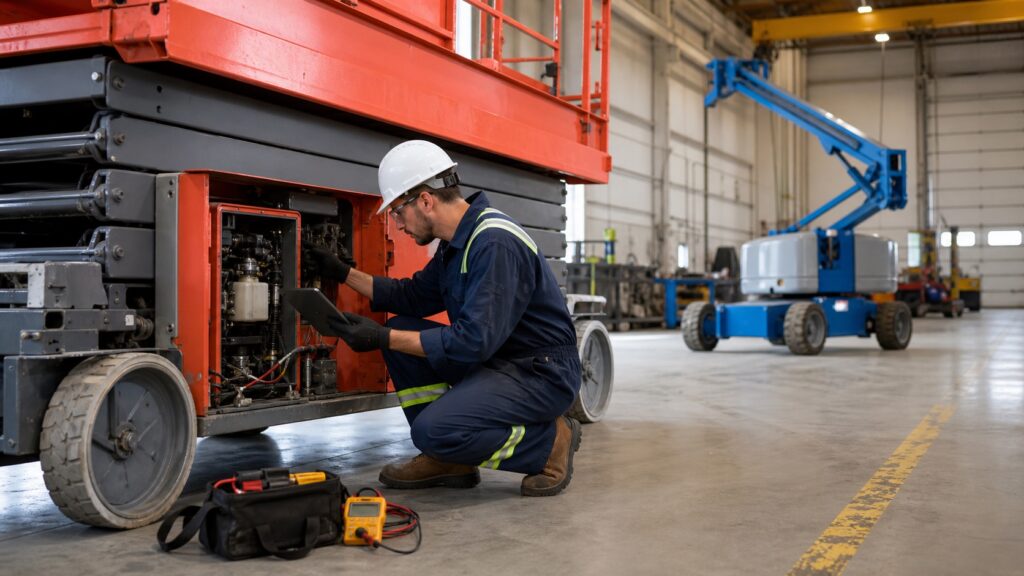
Unplanned downtime is expensive for any aerial work platform fleet. A machine that cannot pass its pre-use inspection may delay a job, interrupt a rental, or force a service team to arrange an urgent repair. The direct repair cost is only part of the loss; transport, technician time, idle labor and missed schedules can add much more.
Preventive maintenance helps fleet owners identify small problems before they become job-stopping failures. It does not mean replacing every component early. It means inspecting the right systems, recording what changes over time and planning service according to the machine manufacturer’s maintenance manual.
Why Aerial Lift Downtime Often Starts With Small Warning Signs
Many breakdowns develop gradually. A weak battery may first appear as slower functions. A damaged connector may cause an intermittent fault before the machine stops responding. A small hydraulic leak may become a low-fluid condition or contaminate surrounding components.
Common early warning signs include:
- Longer charging times or reduced operating time
- Intermittent controls, fault codes or delayed functions
- Hydraulic seepage around hoses, fittings or cylinders
- Loose connectors, damaged cable insulation or corrosion
- Uneven tire wear, wheel damage or unusual drive noise
- Worn platform controls, switches or emergency-stop buttons
- New vibration, heat, odor or abnormal sound
Reporting these symptoms early gives the maintenance team time to inspect the machine in a controlled setting instead of responding after a failure at the jobsite.
Build the Maintenance Plan Around the Manufacturer’s Manual
There is no single service interval that fits every scissor lift, boom lift and vertical mast lift. Machine design, operating hours, environment and duty cycle all affect the maintenance requirement. The correct starting point is always the service manual for the exact model and serial-number range.
A practical fleet program normally separates work into three levels:
- Pre-use or shift inspection: checks completed before operation to identify visible damage, leaks, missing components and abnormal functions.
- Scheduled preventive maintenance: service completed at the intervals specified by the manufacturer, often using operating hours and calendar time.
- Periodic or annual inspection: a more detailed examination performed by qualified personnel in accordance with applicable requirements and the manufacturer’s instructions.
Machines used outdoors, in dusty facilities, near salt water or on multi-shift schedules may need closer attention than machines operating in a clean indoor environment.
What to Check Before the Machine Goes to Work
A consistent pre-use process is one of the fastest ways to reduce avoidable downtime. Operators should follow the machine manual and company procedure, but the inspection commonly includes:
- Machine identification, inspection status and service documentation
- Guardrails, entry gate, platform floor and attachment points
- Tires, wheels, fasteners and visible structural components
- Hydraulic hoses, cylinders, fittings and evidence of leakage
- Battery condition, charger cable, terminals or fuel system
- Wiring harnesses, connectors, control boxes and switch condition
- Emergency controls, alarms, interlocks and function tests
- Decals, operating instructions and required safety information
If a defect could affect safe operation, remove the machine from service and have it evaluated by qualified personnel. A preventive-maintenance program should never be used to justify operating damaged equipment.
Track Operating Hours, Environment and Repeat Faults
Maintenance records become more valuable when they show patterns rather than isolated repairs. For each service event, record the machine model, serial number, operating hours, reported symptoms, fault codes, inspection findings, corrective work and parts used.
Useful fleet-level questions include:
- Which machines repeatedly return with the same fault?
- Do battery problems increase during a particular season?
- Are damaged cables associated with a specific jobsite or transport method?
- Does one model consume a particular switch, sensor or wear item more frequently?
- Are service intervals being missed because operating-hour data is incomplete?
These trends help managers improve inspection procedures, operator training and parts stocking instead of repeatedly treating the symptom.
Use a Focused Spare-Parts Strategy
Downtime can continue even after the fault is diagnosed if the correct replacement part cannot be identified. A useful spare-parts plan is based on fleet population, failure history, supplier lead time and the operational impact of each component.
For every stocked part, keep the OEM reference, machine model, applicable serial range and a clear description. Photographs of connectors and labels can also prevent ordering errors. Do not rely only on appearance: two parts may look similar while using different electrical specifications, software revisions or connector pinouts.
High-use consumables and proven repeat-failure items may justify local stock. Expensive electronic assemblies with low failure rates may be better handled through a reliable supplier and an agreed identification process. The goal is to reduce waiting time without filling the storeroom with parts that do not match the fleet.
Repair the Root Cause, Not Only the Failed Part
A replacement component can fail again when the original cause remains. Before installing a new controller, switch, sensor or harness, check related systems and the environment around the failure.
| Observed Problem | Related Checks |
|---|---|
| Repeated battery discharge | Battery age, charger output, terminals, cable condition and charging practice |
| Intermittent platform controls | Connector locking, cable strain, moisture, damaged wiring and controller fault history |
| Hydraulic component failure | Fluid level and condition, contamination, leakage, pressure and hose condition |
| Premature tire or wheel wear | Operating surface, loading, alignment, fasteners and transport damage |
| Recurring sensor fault | Mounting, adjustment, wiring, contamination and machine calibration requirements |
When electronic calibration, structural repair or safety-system diagnosis is involved, follow the manufacturer’s procedure and use appropriately qualified technicians.
A Simple Workflow for Reducing Downtime
- Create a machine register with model, serial number and operating hours.
- Use model-specific pre-use and scheduled-maintenance checklists.
- Require operators to report new symptoms immediately.
- Record fault codes and conditions before disconnecting components.
- Identify parts by OEM reference and serial-number applicability.
- Analyze repeat repairs and correct underlying causes.
- Review parts stock and supplier lead times using actual fleet data.
This workflow connects operators, technicians and purchasing staff. Each group receives better information, and machines spend less time waiting for diagnosis or the correct part.
Frequently Asked Questions
How often should an aerial lift receive preventive maintenance?
Follow the interval and procedure in the manufacturer service manual for the exact machine. Operating hours, calendar time and working environment may all affect the schedule.
Can a daily inspection replace scheduled maintenance?
No. A pre-use inspection helps identify visible or functional defects, but it does not replace the scheduled and periodic maintenance required for the machine.
What information helps identify the correct replacement part?
Provide the full machine model, complete serial number, OEM part reference, clear photos of the original part and connector, and any relevant fault or controller information.
Final Takeaway
The best way to reduce aerial lift downtime is to combine early inspection, model-specific maintenance, accurate service records and disciplined parts identification. Preventive work turns unexpected failures into planned service and gives the fleet team more control over cost and availability.
Browse more aerial lift maintenance resources, or contact ISLAND with the machine model, serial number, OEM reference and photos when you need help identifying a replacement part.